
A Fracture in the Light ~ Book One of The Seravok Saga
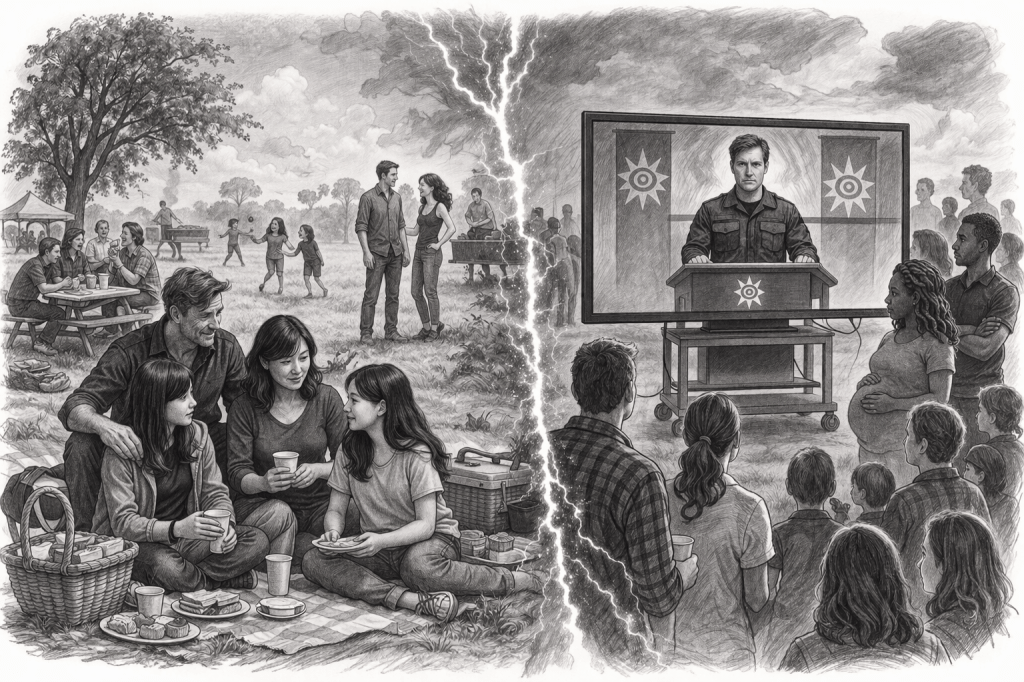
The field behind the office looks newly alive. Folding chairs and picnic blankets dot the grass, children running wide loops with kites and battered soccer balls, the scent of charcoal hanging warm in the air. Someone turns hot dogs on the grill while another passes paper cups of lemonade. A portable speaker on a folding table plays an easy summer playlist. Under a canopy near the building, a television cart from the lounge shows a baseball game with the volume low. A small radio sits beside the grill, wrestling with reception between bursts of chatter. For once there are no deadlines, no meetings to rush. Only people enjoying the day.
The warmth sits heavier than it should for early summer. Near the grill a man from accounting clears his throat into his fist, then again, waving off the look his wife gives him. Two tables over, someone in a long-sleeved shirt keeps to the shade despite the heat, turning down an offer to join the game on the hill. Someone jokes that “the summer flu’s making rounds early this year,” and a few laugh, uneasy. Near the grill, the small radio crackles between songs and half-caught headlines before static wins and someone changes it to music. “…isolated clusters…fever…” No one gives it weight. It is too fine a day to borrow worry.
I move among them, pausing every few steps as someone stops to shake my hand or thank me for hosting. The company is young and growing quickly. A dozen families have come today, employees with spouses, children, and friends in tow. They laugh together, trading plans for summer trips and birthdays. It is the sort of gathering I have seen many times across a long life, and I still marvel at it.
Selena and Liora cut across the grass barefoot, dark hair streaming behind them. They race each other more than the others now, that first edge of competition breaking through the laughter. Younger children chase after them. They take after their mother’s straight black hair more than my own long wavy dark brown. At twelve they still carry the restless energy of childhood, though the lines of who they may become are beginning to show. Serenya says their bodies are growing faster than they know what to do with. Sleepy one day, restless the next.
Selena’s hair falls straight and glossy, her stride quick and sure. Liora’s hair carries a loose wave that hints at mine, her path less direct, as if impulse tugs her sideways by the elbow. Fraternal twins bound by a shared spark. They clutch streamers like ribbons of flame while two other children give chase. Liora glances back as she runs.
“You’re watching?”
“Always,” I say, and the smile gets there before the words. Selena cuts behind a picnic table and bursts out ahead with a triumphant laugh that earns a few chuckles nearby. Liora slows, mock-pouting at the loss, but the gleam in her eyes says she will demand a rematch before long.
From across the field Serenya’s voice carries, sharp with maternal instinct and softened by affection. “Liora-chan, Selena-chan, abunai! Watch where you are running.” They trade a quick grin over their shoulders and speed up instead, causing their mother to shake her head. They weave past the others rather than joining the chase, turning play into something that looks almost like sport.
“The boss’s daughters are running the show,” one of my employees says warmly.
“They usually are,” I say, pushing my glasses up the bridge of my nose. A few of the men chuckle at the familiar sight. They think of me as tall and bookish, dark hair combed neatly, eyes hidden behind glass that never quite fit right. The truth is I have never needed them, not once, but they soften me, make me seem ordinary. People trust a man in glasses, a little less commanding and a little more approachable. That suits me. On some days I almost believe the disguise myself.
Serenya’s laugh carries across the tables, warm and bright. “He looks the same as when I first met him. Perfect skin. Not a grey on him. Years pass and he just doesn’t change.” She shakes her head with the fond exasperation of someone who has mostly made peace with the unfairness of it. “Good genes, he tells me. I’ve mostly kept up… I only hope our daughters get his. Liora’s got more of his features already.”
Angela, resting nearby, smooths a hand over the round curve of her stomach, six months along and showing it. “Every wife hopes the same,” she says. “The best of our husbands passed on down. Between you two I’m sure your girls are set.” Those two have been close for years, their friendship built at several of these picnics, long before Angela married James.
I do not correct the explanation. Good genes. It is what she believes, and I have never given her reason to think otherwise.
I linger near a smaller table where Mr. Alvarez waves me over. His fishing story draws laughter from the colleagues around him. The boat engine failed, the cooler tipped, and he returned home sunburned and empty-handed. “Next time,” he says with mock solemnity, “I will bring sandwiches and call that a picnic.” I clasp his shoulder, share his grin, and move on.
I let the sound of the day wash through me and try to hold on to it. Children laughing. Conversations that carry no fear. People who feel secure enough to speak without guarded tones. I have lived long enough to know how fragile such moments are. That is the odd part. Everyone else lives inside the moment, light as the breeze that sends paper plates sliding off knees. They see the world as a wide road stretching forward. I know how quickly roads end. Even here, in this small corner of peace, I carry that truth at the back of my mind.
Still, today is a good day. I let myself enjoy it.
I drift toward the maple’s shade where a few people have gathered. Serenya sits among them with her easy poise, a stray strand of hair pinned behind her ear. Always the hostess. She makes managing events like these so much easier. James Whitfield sits there now beside Angela. He is easy to spot, tall and broad at the shoulder, dark skin catching the light as he helps her settle onto the blanket. James has been with me since the beginning, the kind of man people trust without needing to explain why.
Angela leans back carefully, one hand resting over the curve of her stomach. Her hair is braided against the heat, and her tired smile brightens as the other women trade stories about cravings and sleepless nights.
“Glad you pulled us all out here,” James says, standing to shake my hand. “Angela needed this more than she’ll admit.”
“I think we all did,” I say. “And she’s got the best excuse to sit still.”
Angela smiles. “This is much preferable to HR forms. But don’t let him fool you. He hovers worse than a nurse.”
That draws a ripple of laughter. Serenya, balancing a plate for the children, leans in with a grin.
“When I was pregnant with the twins,” she says, “Gabriel acted as if he had never seen a pregnant woman before.” She glances across the field to where the girls chase ribbons through the heat, the look lingering a beat longer than it needs to. Pride there, and something else alongside it. An awareness that their childhood is already shortening. “Hovering does not begin to cover it. He built a shiro of pillows around me every night. My own private fortress.”
The women laugh louder. Angela shakes her head in sympathy. James gives me a knowing look, and I lift my hands in surrender.
“Some things are worth being careful about,” I say.
Angela’s smile lingers, then shifts. “So if he was that prepared, why no more after the twins?”
James chuckles. “Man builds a pillow citadel once and retires undefeated.”
Serenya’s laugh comes easy, and her answer is plain. “We decided not to try again. We’d been trying for a while and given up hope. We were even pretty far into the adoption process when we found out. Two at once felt like luck we weren’t meant to press. We promised each other we wouldn’t chase it a second time. If more came, we’d welcome it. If not, our hands were already full.” A small, warm smile. “Especially considering twins aren’t common in Japan. I thought my dad was going to have a fit. My grandfather, though, he just chuckled.”
We let that stand. It is the truth we share. The rest stays with me. In all my long years the twins are the only proof I may father children at all. Until I understand why they are possible, I will not gamble with Serenya or with another life. I had even, in a moment of weakness, tested to confirm they were indeed mine. Nothing odd came from the simple test I ran, and I left it there.
James squeezes Angela’s hand. “Fair enough. You made good ones. I’m sure just having this one is gonna be handful enough on its own.” Laughter rises again and the moment eases. Talk drifts back toward ordinary things. I step away, drawn by a swell of laughter near the grill.
A cluster of older staff lean against the tables while a pair of younger hires try to manage the supply side of things. Marcus Ellison stands in the middle of it, tall and wiry, curls that refuse to lie flat, grin quick and hopelessly unconvincing as he defends himself. His younger sister Danielle stands beside him with arms folded, shorter, sharp hazel eyes reading the scene. A Saint Christopher medallion glints at her throat when she moves. She keeps a small spiral notebook tucked in her back pocket, and I can already see a list started for quantities.
“That’s not how it happened,” Marcus says, rummaging. “I set the cups out by the cooler.”
“You set them somewhere,” Danielle answers, amusement shading her voice. “Which isn’t the same thing. This is why you write stuff down.”
He finds the missing cups half-hidden behind the fruit bowl and raises them like a trophy. “Exactly where I left them.”
“Which isn’t where you said.” Danielle shakes her head at him. “Meu Deus.” The tables break into fresh laughter.
They fall into an easy rhythm, ribbing each other while passing cups and plates. Their banter blends into the music, the kind of teasing only family, or something that has grown close enough to be, can comfortably carry.
I watch with a faint smile and feel a small pull of recognition. I have the same habit, setting something down in an old spot without thinking, reaching for it later in the place it should be rather than where it is. Happens too often to count.
On the far side of the hill, a knot of boys wear grass stains like trophies from an impromptu match. The girls run down the slope too fast to stop, laughter breaking free in the rush. The speaker slides to a new song. The television under the canopy flickers as someone adjusts the power cord, then steadies.
Serenya meets my eye across the tables and lifts two fingers in a small question. I nod. Plates, napkins, a second bottle of ketchup. I cross to her and set them down. Her hand brushes mine in a brief thanks. We do not need words for these small tasks. We have practiced marriage long enough that motion carries what sentences once did.
“Do you remember the first company picnic?” she asks.
“I remember you insisting we invite children,” I say pausing to take her in. “You were right.”
“I am often right,” she says, and her smile softens the boast.
“I know,” I say, the grin spreading across my face.
For a moment I do nothing but listen. The low hum of the crowd. The soft hiss of the grill. Wind moving through maple leaves. A child’s thin whistle. The television’s murmured play-by-play drifting from under the canopy. A plane far overhead, slow and bright. The sound is ordinary and priceless.
I let myself believe it can last.
Almost too quietly to notice, the music falters.
The speaker by the folding table stutters once, then drops into a hollow hiss. Someone reaches over and taps it, as if the sound might come back by habit alone. Static answers.
Under the canopy, the television flickers.
The baseball game freezes mid-pitch, the runner caught between bases. The image tears, clears, then snaps to a different feed. A red banner crawls along the bottom of the screen, bold white letters breaking the familiar frame.
A woman’s voice is already speaking. “—this is an emergency news update. We are interrupting regular programming—”
No theme music, no transition. The set is wrong. The desk is bare, the lighting harsher than usual, shadows cutting deep across the anchor’s face. She is not the one normally on this channel. She glances sideways, listening to someone off-camera, then looks back into the lens.
A few people laugh uncertainly. “Did they just cut the game?” someone says. A hand reaches for the remote. The channel changes.
Different network. Different anchor. The same urgency, already mid-sentence.
Another change. A scrolling ticker that stutters, then races. A weather channel stripped of maps and forecasts, replaced by a live desk and a hastily assembled graphic with marks across a national map.
A cartoon fills the screen next, loud and unchanged, its cheer completely out of place from the other channels.
Back to cable news. The familiar red and black palette, the anchor speaking too fast, words colliding as updates arrive faster than they can be shaped.
People stop moving.
Serenya is suddenly beside me. I do not hear her cross the grass, only feel the shift of her presence at my shoulder. She looks at the screen, then up at me, searching my face for context before she speaks.
“What’s happening?”
“I am not sure yet,” I say. My voice stays even. I keep it so.
“…reports that began earlier this week of isolated, unexplained deaths have escalated rapidly,” the anchor says. “Hospitals in multiple regions are now reporting a surge in critical cases.”
A beat, and her expression tightens. “We have video from inside several facilities. We want to warn viewers that some of what you are about to see may be disturbing.”
The image changes. Shaky footage replaces the desk. A hospital corridor choked with gurneys. Patients lie rigid and sweat-soaked, dark veins standing out stark against pale skin. A man arches once, gasping, then goes still as a monitor shrieks until a hand slaps it silent.
The broadcast returns to the anchor. Her jaw tightens. She swallows before continuing.
A few parents call their children closer, voices kept deliberately calm. The twins race past us, laughter bright, streamers snapping in the air. Liora glances at the knot of adults by the television, curiosity tugging at her stride.
“Later,” Serenya calls gently. “Stay where I can see you.”
They slow but do not stop. They drift closer now, sensing the shift in the air even if they cannot name it.
On screen the footage tightens. A close shot. Skin slick with sweat. Darkened veins standing out along a man’s neck, branching toward his jaw. His eyes are open but fixed on nothing. Someone off-camera says his name. Once. Then again.
I barely hear the medical voice continuing over the image. I see the veins. The fever. The way his gaze does not track the room.
I know this sequence.
“…reports now extending beyond national borders,” the anchor says. “We are receiving confirmations from overseas.”
Serenya’s fingers curl lightly into the fabric of my sleeve.
The ticker updates. Location names scroll past too quickly to read.
The field has gone quieter. Most eyes are on the television. Laughter still drifts from children further out, unaware of the weight settling over the adults. A few drift back toward the group, drawn by the stillness without quite knowing why.
“Air traffic is being grounded nationwide,” the anchor continues, eyes flicking between her notes and the scrolling ticker, “and spaceflight operations are standing down as tracking and ground control degrade. Officials say crews already in orbit are sheltering in place. There is no indication they have capacity to assist ground response…”
A moment later a second anchor steps into frame, jacket hastily straightened, tie loose. He listens as she finishes, eyes shifting off-camera before sitting beside her.
“We’re getting preliminary reports from hospitals as fast as they can send them,” he says. “Doctors are stressing this isn’t analysis, just what they’re seeing right now.”
A graphic flickers beside them, half-formed. “In many cases, patients reported feeling unusually well before symptoms appeared. More energy than normal. Old injuries and chronic pain easing or disappearing. Several described it as feeling better than they had in years.”
A low murmur moves through the adults, puzzled voices overlapping, disbelief edging toward unease. I stay quiet, eyes on the screen. The words pull at something old and unsettled, a memory that has no business being here.
Near the supply tables, Danielle has already pulled the small notebook from her back pocket. She writes quickly, pausing only to glance at the screen before adding another line.
“That sounds… backwards,” Marcus says, reaching for lightness. “Like your body’s doing a victory lap before it falls apart.” Danielle shoots him a flat look. The moment hangs. Marcus clears his throat and shifts his weight, the joke settling where it died.
“Those reports are followed by sudden fever,” the second anchor continues, words arriving faster now. “Then visible darkening beneath the skin. Veins becoming pronounced. Spreading.”
The graphic updates. Black lines creep across the body outline on screen.
James steps closer to Angela and helps her to her feet, one arm steady at her back. She moves carefully, one hand resting over her stomach as she leans into him.
“Severity appears age-related,” the anchor says, checking his notes. “Young children are showing no symptoms. Some younger teens have been affected. The majority of critical cases remain among older teens and adults.”
He pauses, listening, one hand lifting toward his ear. “Onset appears to vary. Initial symptoms can take several days to emerge after exposure. However, once they begin—” He stops. His eyes drop to the page, then come back up. “Once they begin, decline can be rapid. Some reports indicate death sometimes within the day.”
A beat of silence.
“Within—” He pulls in a short breath, confusion crossing his face. “Within the day.” Steadier now, but only just, the anchor forcing the words into something that sounds like professional distance. “Uhm. We are being told some cases are progressing that quickly.”
The feed cuts to a hospital wing. Beds line the corridor, spaced too close, some separated only by pulled curtains. Patients lie rigid or curled, monitors sounding in an uneven chorus. On one bed a woman grips the rails, dark veins visible along her arms as her breathing turns shallow and uneven.
Danielle writes again, the pen pressing harder into the page.
The details arrive together in my mind, slotting into a shape I recognize. The sudden sense of health before the collapse. Bodies repairing themselves. Then the fever. Then the black veins spreading beneath the skin.
I know this. But it cannot be possible. Everything tied to it was destroyed, every record, every sample, every trace. For three months, even what remained in the lab was no longer contagious, unable to spread. We had rendered it inert. Then the explosion took the lab, fire and debris and nothing left to salvage. I was there when it burned.
Around me people stand closer to the television. James shifts his stance, putting himself between Angela and something that has no shape yet. Marcus folds his arms, jaw set now, eyes no longer reaching for humor.
The anchor is still speaking when the broadcast stutters.
The image tears, sound warping for a single heartbeat before snapping back.
Not to the anchors.
A group fills the screen.
Black banners hang behind them, each marked with a star set atop a stylized eye. Children stand in straight rows at the back, quiet and watching. Five adults flank the man at the center, still and composed. All in uniform.
Text holds along the bottom of the screen.
DOMINION
“My name is Adrian Marrick,” the man says. His voice is steady and controlled. “Be not afraid. What you are seeing unfold across the world was not unforeseen.”
The breath leaves me.
Caelithar.
The recognition is as immediate and absolute as it has always been across every century between us. The name he decides to answer to does not matter. The face beneath it does not change.
My mind races over what I am seeing, trying to account for how any of this could have reached him. Nothing fits. Nothing should fit. But there he stands.
Serenya’s hand tightens on my arm. The twins have closed in beside her, sensing the change without understanding it. She watches my face, offering the only comfort she can.
I let her. I cover her hand with mine.
“We have food,” Caelithar says, his gaze fixed on the camera, calm and unhurried. “Shelter. Structure. The things the world abandoned long before this began.”
He pauses only briefly.
“What you are seeing is not chaos. It is correction. Humanity has been drifting for years, cutting itself loose from responsibility, from restraint, from anything that held it upright. This is not the first time it has needed to be culled.” Another pause, shorter. “We are here to preserve what can still be rebuilt. To protect those who can begin again. The children.”
The camera widens slightly. The adults behind him do not move. The children do not look afraid. “We are not affected by this plague,” he says. “My generals and I are immune.” He lets that sit for a moment.
Immune? Caelithar being unaffected would make sense, like me at the beginning. But not the people around him. Those five are a different question, and I have no answer for it yet. If he got his hands on the plague, did he get his hands on the cure as well? What has he been doing since the lab burned? How long has he been building this? Who else has he found, and how? The questions stack faster than I can sort them.
“The children will also be spared. Those under the age of maturity will not carry it, and will not fall to it. The plague itself will run its course within the year. What remains after that will be a world that finally has the chance to begin again, under order. Under guidance.” Around me people shift without meaning to. Hands find small shoulders. Arms draw children in close.
A year. I turn the word over. It is a specific claim, the kind that either comes from knowing or from calculated manipulation. Caelithar has never been a careless speaker. He does not say things to comfort. If he is putting a timeline on the air in front of the world, he believes it, or he wants people to act as if it is true, which is a different kind of certainty. I find, unsettlingly, that I believe him. I cannot say why with any confidence, but I do.
How long has he known about this outbreak? How long has he been watching it spread before stepping in front of a camera? And those five beside him, standing still as soldiers who have drilled for months rather than days. What has he built while I was not looking?
Immune though. If those adults are immune as he claims, if this protection runs through them the way it once ran through us, then that would mean—
“If you are listening,” Caelithar says, his gaze steady, “know this. Survival afterward will not be equal. It will require strength. Discipline. Unity.”
The feed cuts.
Half a second of static.
Then the anchors snap back, voices overlapping, someone in the background yelling, neither of them yet aware the camera has found them again. She places a hand to her ear and quickly looks toward the camera. “We’re— we’re back,” the woman says, blinking hard, clearly mid-sentence when the feed returned. “We apologize, we didn’t— that wasn’t scheduled.”
The man beside her leans forward, hand also pressed to his earpiece. “We’re trying to determine how that signal interrupted the broadcast. We can’t verify any of the claims made in that footage.”
She nods too quickly. “There are early indications this may be a coordinated hack. Possibly a group attempting to take credit for the outbreak.”
The screen splits. Off beyond the field, a siren begins to sound. Then another, further away.
Serenya draws the twins fully against her, one hand resting at each small back. She stays close enough that I can feel her steady breathing beside me.
I do not look back at the television.
I am still trying to make any of this fit together, and none of it does.
 Tasel's Ramblings
Leave a comment